


You thought “Sunday Scaries” would fade into a silly memory from your high school and college days.
Yet, to your surprise, they stuck around… well into adulthood.
It’s no longer a feeling of panic though; it’s more like a soft unease that bubbles up to your consciousness around the time you finish dinner and clean up, seeing the sun setting, knowing you’ll be back on the freeway before it fully rises again. You wash another dirty dish and wipe your countertop, your mind clocked into the office before your feet have even left the kitchen.
The feeling lingers as you complete another Sunday night doomscroll that feels more like an awkward ritual of housekeeping rather than true enjoyment.
Instagram shows you a reel of someone attractive snowboarding under a bright pink sky in Switzerland because the algorithm knows your feelings of inadequacy are a part of what keeps you scrolling.
You forget the video the second you put your phone down, but your emotions keep the memory tucked away in your nervous system.
You avoid thinking about the day that lies ahead: waking up and spending your Monday the way you’ve spent every Monday for years on end - trading away another day you’ll never get back, doing work you didn’t choose, for the same dollar amount to hit your checking account next Friday.
The number is enough to keep you coming back... but never enough to make you feel like you’ve “made it”. You continue your routine and pretend you never questioned it.
Most people never question this feeling. Across the world’s largest ongoing study of workers, Gallup found that only 20% of people are actually engaged at work. Put another way, for half their waking life, 4 in 5 people are living a life of mental vacancy. They show up to endure another week, pulled forward by the prospect of another weekend that pacifies, but never fully revives them.
Rinse and repeat.
~
We donate our present for the assumed promise of a better future, but deferred gratification in the extreme can quickly become dangerous. A lived example of this is a true story about a man we’ll call “Uncle.”
Uncle did everything right. He kept his head down and pushed through a 40-year corporate slog. He paid himself first, dropping money in the 401k every other week. Vacations were minimal. His financial acuity and responsible thinking allowed him to retire comfortably at 62.
At last, he’d reached the finish line he’d been working towards his entire life. He finally got to relax. To live out all the dreams he’d been deferring until after retirement. After all this time - all this effort - he was free.
Uncle died a few months later.
~
After 26 years of life, I’ve only recently come to a strange realization. We weren’t born truly free. We were all born inside something invisible - an abstract “machine” built long before you got here, that will still be running long after you leave. It’s so subtle, so constant, you can’t differentiate it from the fabric of the natural world - like an air-handling unit that’s always running but doesn’t grab your attention until it suddenly shuts off.
You can’t see the machine because you’re inside it. You’re a part of what keeps it running. To prove it, let’s show the assembly, one gear at a time.
GEAR ONE | THE EMPTY PROMISE
Imagine the 16-year-old version of you: who you were, where you lived, and how you spent your time. You’re young and eager, ready to grab the world by the short hairs.
Someone you trust hands you a map. It’s a bit weathered and worn-out, but you can still read it just fine.
“Go to school. Get the degree. Get a good job. Live a good life.” It reads. No explanation included. Not one of many possible paths. THE path. The only serious one, at least.
So you do what millions of others did, and still do. You take the map and accept it as gospel. You choose a career path before you know how you like your eggs cooked. You go to school and relentlessly study for four (maybe six, maybe eight) years straight. You did everything they told you to, in the exact order you were supposed to.
Now look back at where you’re standing.
The map wasn’t built to free you, but to sort you. To put you in a box, on a shelf next to countless other boxes. To determine the one-track career path you assumed you needed to dedicate your entire life to.
~
John Taylor Gatto spent thirty years in public education, winning New York State Teacher of the Year. Knowing the system from the inside out, he eventually quit his job - spending the backend of his life arguing that mass schooling was never designed to educate, but to produce manageable citizens.
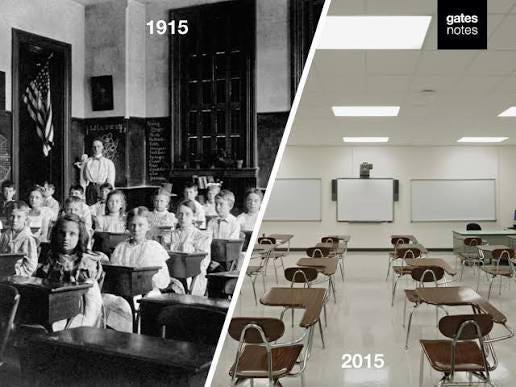
The model is largely inspired by the education system of 19th century Prussia, engineered to manufacture obedient soldiers and prevent insubordination. A system built to create people who willingly stand in single-file lines and orderly rows. Who follow instructions and avoid all flavors of failure. Who can answer any question but never learned which questions were worth asking.
This was never a secret. In 1909, the president of Princeton gave a speech to the New York City School Teachers Association:
“We want one class of persons to have a liberal education, and we want another class, a very much larger class, to forgo the privileges of a liberal education and fit themselves to perform specific difficult manual tasks.”
The man who pushed for two distinct classes ended up speaking to more than just schoolteachers. That speaker’s name was Woodrow Wilson. And 4 years later, the guy became the 28th president of the United States.
Within his two terms in office, the Smith-Hughes act was signed into law, establishing the first federal grants for industrial education, aiming to prepare the working-class youth for industrial jobs. The year after, the country hit a milestone where every state required all children to attend schools.
The education system as we know it today was built on the objective of sorting students into boxes before they had the chance to consider what they wanted for themselves.
The lines between these arbitrary “classes” are blurring together more so everyday. We’re watching a propped-up structure collapse before our eyes.
The average American borrower of student loans carries around $39,000 in student debt. In the meantime, 43% of recent graduates are “underemployed”, meaning they’re working jobs that never needed the degree they’re still paying off.
There’s no villain in this story. It doesn’t boil down to a single culture, institution, or corrupt politician. The machine simply runs the program it was built for. And for the longest time, the program thrived on promises that slowly hollowed out until they disintegrated.
GEAR TWO | THE ILLUSION OF SAFETY
The map we followed led us all to the same place: a job. As the dust of our early years settled, this registered as solid ground. We now have a title, decorated with important responsibilities. Best of all, we have a direct deposit breathing life into our bank accounts because of it.
When someone asks you how you’re doing, you say “can’t complain!”, convincing yourself it means the same as “great!”
This is where most people spend a majority of their lives - where the dread is nearly silent, nearly invisible, but present as ever.
Most people never notice it… or they learn to make peace with it.
Let’s call a spade a spade. This way of life isn’t half as stable as you’d like to think. It’s the single most concentrated bet a person can make. 100% of your income, spoon-fed from one company, dependent on one manager’s opinion of you, all hinged on ever-shifting quarterly metrics you have nothing to do with.
When the next slow season comes around, there’s no promise you won’t be the next one cut without notice, left to tread water before you can even process what happened.
We’d never consider pouring our entire net worth into one stock, yet we tie our entire livelihood to one job and call it safe.
The machine is still running as you sit still. “White-collar” industries have cut more jobs than they’ve created for three years straight. This typically only happens during recessions. 1.2 million cuts were cited in 2025 alone. The ones running the machine, executives of Amazon, Ford, and Anthropic, have all suggested AI could erase up to half of all white-collar work.
The machine doesn’t hide its plans for you; it simply trusts you’re too comfortable to react.
~
Even those treated well by the system have started to feel its effects. Taylor LaSane was working a six-figure finance job at Google. She landed exactly where the dusty map promised she’d go.
But for three straight years, she was silently building her way out, in the margins of time between her demanding job and raising her twin toddlers.
At some point, the math flipped. The cost of staying at Google was greater than the risk of leaving. Around the time Google offered her a buyout, Taylor’s Uncle died at 62 years old - the same man from earlier - who did all the right things to set up his future, but never truly lived it.
This was the tipping point that caused her to take the leap. She was still raising two toddlers and knew her business was only earning a tenth of her current salary. This leap wasn’t safe by any means, but she saw the cost of not trying: a life with abundant potential, left on the table. A life that could’ve easily been spent waiting for permission that would never come.
GEAR THREE | THE INVISIBLE WALL
There’s one final gear. It’s the most comfortable, which makes it the most dangerous.
At some point, you stopped dreaming and just started saying “this is how life is.” You told yourself to start being realistic. To grow up. To let your dreams fade into the background until you forget you ever had them in the first place.
This period is where dreams get reframed and relabeled. “Ambitious” becomes “daydreamer”. Asking for more out of life gets called “ungrateful”. “What if?” is responded to with “get real.”
We’ve made a critical error: we confused monotony for maturity.
That living a responsible, yet emotionally-flat life is simply the price of being a serious adult. In reality, the machine is running its oldest programs on you - draining the sovereignty out from our souls, conditioning us that the only way to survive well is to follow the well-trodden path - the one covered in muddy footprints because everyone else had already walked it.
What you weren’t supposed to notice is how the walls of the 20th century have collapsed. You don’t need capital, a year of runway, a team of developers, or permission from authority.
All of this has crumbled, seemingly overnight.
One person with a laptop can now do the work of ten. The share of businesses started by a single founder has risen from 23% to 36% in the last five years. The setup that once cost a payroll and office rent now costs the price of a Shopify store and a Claude subscription.
AI, the very thing placing your current job at risk, is the same thing charting the escape route to free you on the other side.
This idea crumbles the old barriers of the past, the same walls Taylor LaSane noticed were no longer there. She didn’t have an empire to fall back on, but she noticed the hurdles that would’ve stopped her 20 years ago no longer existed.
The stone unturned here is the reality that simple doesn’t mean easy. Most solo businesses don’t make anyone rich. 34% of small businesses report annual revenues under $50K and 91% of businesses make less than $1 million annually. Online entrepreneurs like to position a solo venture as a winning lottery ticket, when that often isn’t the case.
But getting rich was never the point. The point is how the cost of trying is nearly zero. Any excuse that would’ve worked in the past has officially expired. The flat life you called adulthood is the biggest anchor tying you to where you are. The only thing left is to choose differently: both the simplest and most difficult part of the entire journey.
CONCLUSION | THE DISASSEMBLY
Take a step back and observe the entire machine at once. The same programs running from centuries ago: sort them out, assign them roles, keep them comfortable, keep them useful.
It’s important to note the machine isn’t inherently evil. It’s a system that has created a sense of security for generations, and began in a time when security was a dime a dozen. When the system ran the way it was designed to, it made life better for millions of people over many decades. Yet it also feels nothing while doing it.
LaSane’s Uncle lived a life inside the machine. He wasn’t foolish, and he certainly wasn’t lazy or undisciplined. Rather, he was obedient.
Obedient to a program, an empty promise, a vague notion that life was meant to be lived later, once the work was done and permission was granted. Forty years of delayed gratification, waiting for someone to tell him his life was finally ready to begin.
But you don’t need to repeat his mistakes. Now, you can see the entire machine for what it is. You’ve watched it run for decades and called it life. Its power over you only weakens once you can see it clearly.
So here we are, another Sunday evening, another blog post. Our life clocks are still ticking away at one second per second. The machine hums in the background, so gently your ears always mistook it for silence.
There’s no one coming to save you from it.
But that also means there’s no one coming to stop you, either.
So I’ll leave you with a question. The one your boss’s boss has been paying you, every two weeks, your whole adult life, not to ask:
What’s stopping you from living a life that’s truly yours?
-KPG
If this essay resonated with you, feel free to send me a direct message or reply to this email. My mission is to help you design a life you don’t need an escape from- and I’m happy to assist you in any way I can.
See you next week.
Great article. The empty promise gear is where your framework and mine intersect. The map did work, for a while, and part of the reason it felt like it worked is that the economy underneath it was genuinely producing better outcomes for average people. But here is where it gets interesting: if we have been mismeasuring inflation, capturing only the net result rather than the full picture of inflation, then the economy has been quietly delivering less than the data suggests for decades. The promise did not hollow out because people stopped following the map. It hollowed out because the machine underneath it shifted in ways the measurements never captured. So we kept handing the same map to the next generation without realizing the terrain had changed.
The other piece your article touches on without naming it directly is the unintended consequences problem. When everyone gets a degree, the degree stops being the differentiator it was sold as. Nobody planned for that outcome because they were focused on the primary benefit, not what happens when you push it to the extreme. That is the same diagnostic failure: pointing at symptoms, blaming the wrong variables, and never getting to the actual mechanism underneath.
When you finally do find the mechanism things get extremely interesting.
Great article as always, Kyle, and love that you've supported all of your points with research! As a recent undegraduate this is underemployed, I feel this. Ironically, this is by choice, since I hated my previous career so much. But the reason for that is because I never thought long and hard enough about what I actually want to do vs. what my parents/society wanted me to do (for that illusion of safety gear).
But that's why I've always been building things on the side. Always good to not have to rely on one specific "machine" and build out your own to test out what actually works and gives your life the most freedom.